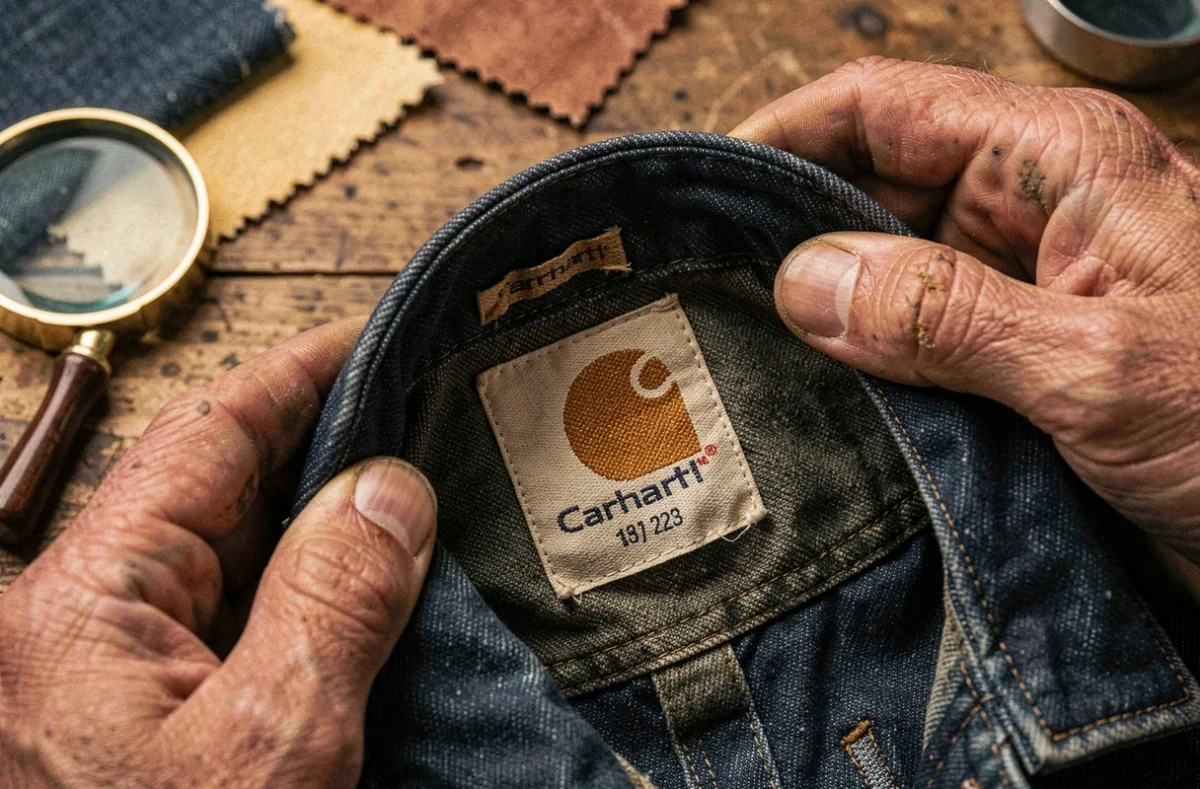
Distinguishing an authentic Carhartt from a counterfeit relies on a range of indicators, not a single criterion. Label, logo, stitching, product reference: each element taken in isolation can be reproduced by a well-crafted counterfeit. It is their overall consistency, related to the model and the time of manufacture, that makes the difference. This article reviews measurable checkpoints, those that allow for a side-by-side comparison of two pieces and help identify discrepancies.
Comparison Table of Carhartt Authentication Indicators
Before examining each criterion in detail, this table summarizes the observable discrepancies between an authentic Carhartt item and a common counterfeit.
| Criterion | Authentic Carhartt | Common Counterfeit |
|---|---|---|
| Logo Spelling | C-A-R-H-A-R-T-T (one r after the h, two final t’s) | Variants: Carhart, Carharrt, Carthart |
| Main Patch | Neat weaving, regular letters, clean edges | Pulled threads, distorted letters, blurry outlines |
| Inner Label | Style/reference code consistent with the model, size, textile composition | Missing, inconsistent, or copied reference from another model |
| Stitching | Regular double or triple stitching, thick thread | Single stitching, thin thread, visible irregularities |
| Fastenings (zip, buttons) | Carhartt engraving or marking, smooth zip operation | Generic zip, buttons without marking or poorly attached |
| Country of Manufacture | Variable depending on the model (USA or “Imported”) | Inconsistent mention with the period or model |
The first reflex to adopt is to remember the exact spelling of the brand. Any spelling variant on a patch or button signals a counterfeit. This point alone eliminates a significant portion of copies.
To delve deeper into the method, recognizing a real Carhartt involves the systematic cross-referencing of several of these indicators, never by checking just one.
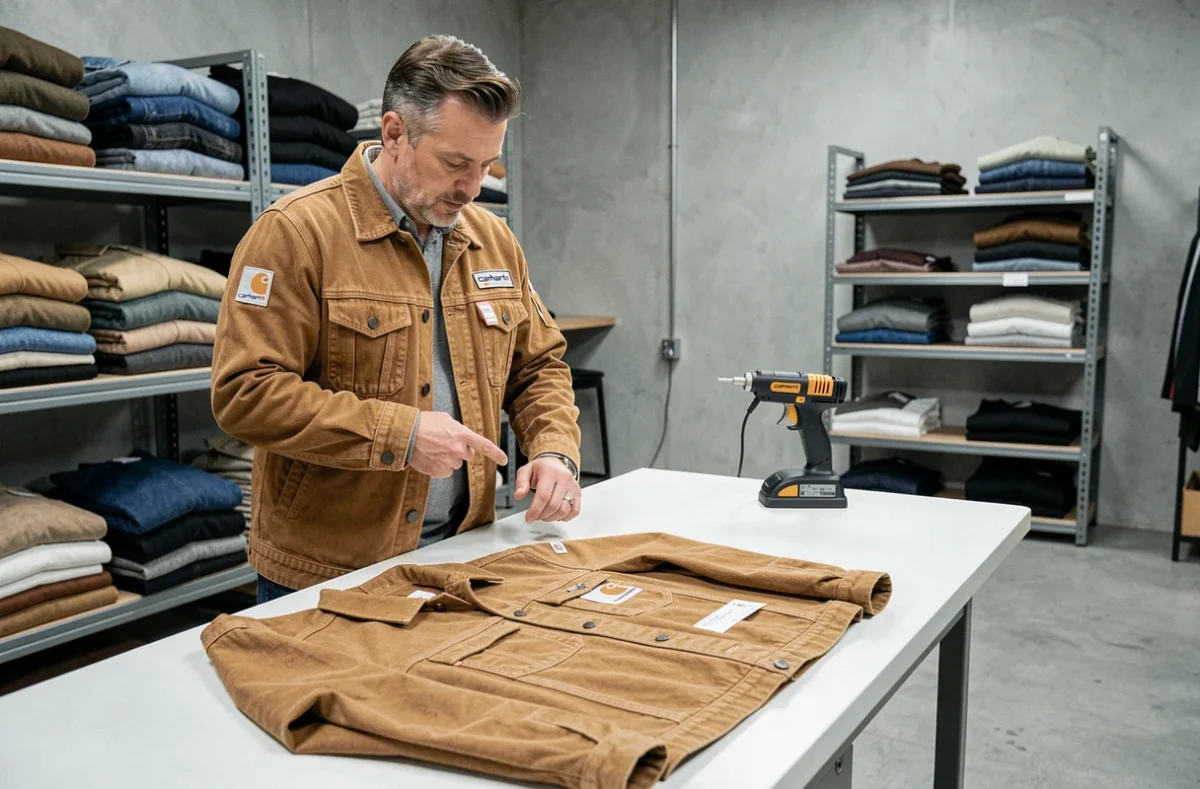
Product Reference and Carhartt Line: The Verification That Copies Fail to Replicate
Counterfeits readily reproduce a logo or patch. Copying the consistency between a reference, a cut, a material, and a color is significantly more difficult.
Carhartt Workwear and Carhartt WIP Do Not Share the Same References
A common mistake is to compare a Carhartt WIP item with the Carhartt Workwear catalog, or vice versa. The two lines have their own catalogs, cuts, and characteristics. Confusing the two lines can misrepresent a legitimate piece as an anomaly, or validate a copy that borrows elements from each.
Before any verification, identify which line the item belongs to. The WIP patch bears the mention “Work In Progress.” The Workwear patch displays the classic logo without this mention.
Cross-Referencing the Reference with the Model Sheet
Each Carhartt garment carries a style code on its inner label. This code refers to a specific model: available cut, material, color. A counterfeit may use an existing code but associate it with a cut or fabric that does not match.
- Note the style code on the inner label of the garment
- Compare it to the corresponding product sheet on the official website of the relevant line (Workwear or WIP)
- Check the match between the actual material, cut, and colors offered for this code
A reference applied to a garment whose cut or fabric does not match is a strong signal of counterfeiting. This cross-referencing takes a few minutes, but it is the most reliable check against well-crafted copies.
Stitching, Zips, and Finishes: The Discrepancies Revealed by Touch
The logo and label can be seen in a photo. Finishes, however, can only be properly judged by hand. This is an advantage for those buying at thrift stores or garage sales, and a weak point for online purchases.
Topstitching and Thread Density
Carhartt uses double or triple topstitching in tension areas (shoulders, armholes, pockets). The thread is thick, and the tension is consistent. On a counterfeit, the topstitching is often single, the thread thinner, and the regularity uneven from one stitch to another.
Irregular stitching in reinforcement areas almost always betrays a copy. On a chore coat or a Detroit Jacket, run your finger along the shoulder topstitching: a misalignment or a looping thread indicates a level of craftsmanship inferior to that of the brand.
Fastenings and Snap Buttons
Carhartt zips bear specific markings and slide smoothly. The snap buttons are engraved. On counterfeits, the zip is generally a generic model without inscription, and the buttons bear no marking or a rough marking.

Carhartt Label and Country of Manufacture: What Traps Buyers on Vinted
On resale platforms like Vinted, the buyer often only has photos. The inner label then becomes the main point of control, but it is also the source of many misinterpretations.
A country of manufacture that is not the United States does not mean counterfeit. The official sheet of a current Detroit Jacket, for example, indicates “Imported.” Requiring the mention “Made in USA” on a recent model would exclude authentic pieces.
What matters is the consistency between the indicated country, the presumed era of the garment, and the model. A vintage Carhartt from the 1990s made in the USA and a recent model made abroad are both legitimate, provided that the entire label (composition, size, style code) is consistent.
- On a vintage item, check that the label style corresponds to the supposed decade (Carhartt labels have evolved over the years)
- On a recent item, the presence of a barcode, a detailed textile composition, and care instructions in multiple languages is normal
- The complete absence of a style code or a low-quality fabric label glued rather than sewn is a warning signal
Authenticity indicators vary by era and model. A holographic label may appear on some recent products, but its absence on an older item is not sufficient to conclude counterfeiting. Each verification must be related to the specific context of the examined piece.
Authenticating a Carhartt never relies on a single detail. It is the accumulation of checks (logo spelling, cross-referencing the reference, quality of stitching, label consistency) that produces a reliable diagnosis. In the face of persistent doubt after these checks, the safest option remains to compare the piece directly with the official product sheet of the relevant model.