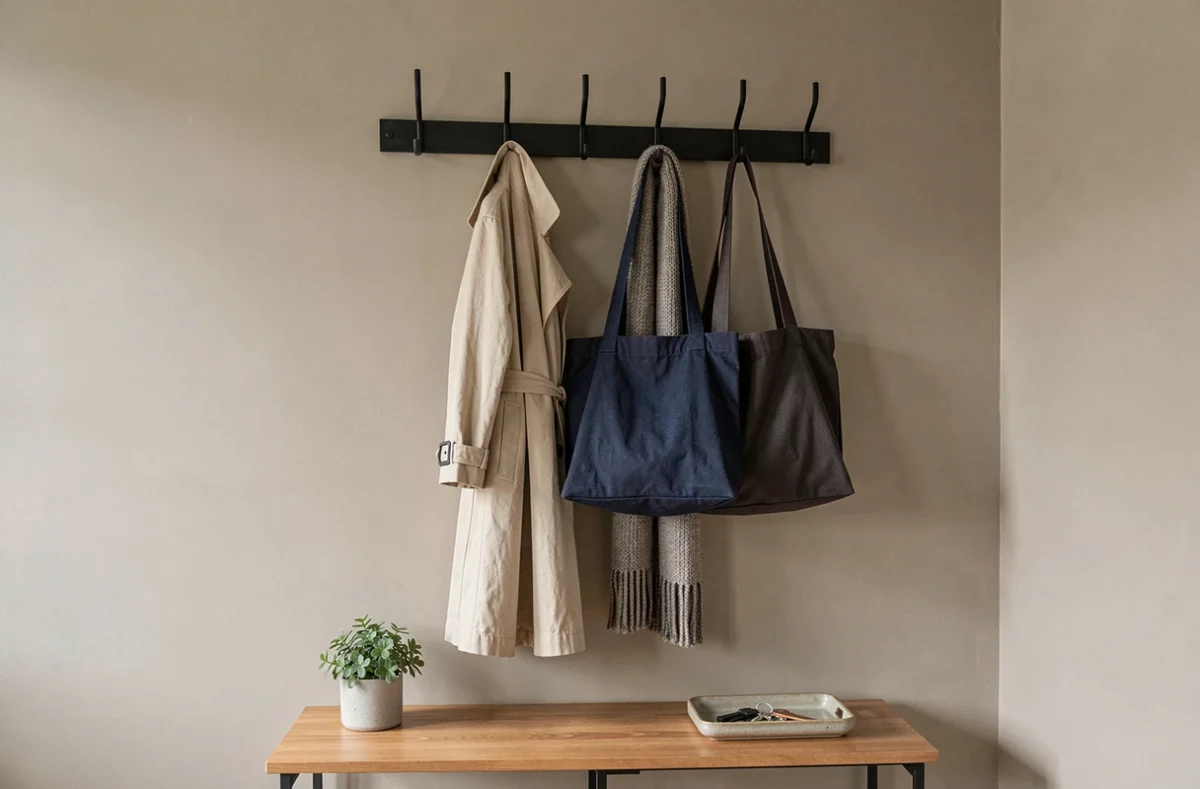
A wall-mounted coat rack plays a distinctive role in an entryway. Choosing the right one means weighing several technical factors that are often overlooked: the type of wall, the actual space taken up once clothes are hanging, and airflow around the hanging area. These considerations go well beyond style or the number of hooks.
Wall mounting: the wall determines which coat rack to choose
Most negative reviews of wall-mounted coat racks concern anchoring, not design. A fixing designed for solid concrete will not hold in a plasterboard partition, and vice versa. Before buying, first identify the type of wall you’re working with.
On a lightweight partition (plasterboard or hollow gypsum blocks), fastening into a metal frame stud provides a much stronger hold than a standard wall plug. For concrete or solid brick, expansion plugs are suitable. For hollow brick, toggle or chemical anchors are preferable.
A wall-mounted coat rack for the home’s entryway only does its job if it stays firmly in place under the weight of several winter coats. The manufacturer’s instructions generally state the maximum load, but that figure only applies to the recommended wall type.
- Concrete or solid stone: standard expansion plugs, drilled with a hammer drill, for a high load capacity
- Plasterboard on a frame: locate the studs with a detector and screw into them, or use Molly bolts in areas between studs
- Hollow brick or hollow concrete block: chemical anchors (resin anchoring) distribute the load without cracking the material
- Solid wood (chalet, paneling on battens): screw directly into the load-bearing wood; pre-drilling is recommended to prevent splitting
How much space hanging clothes really take up in the entryway
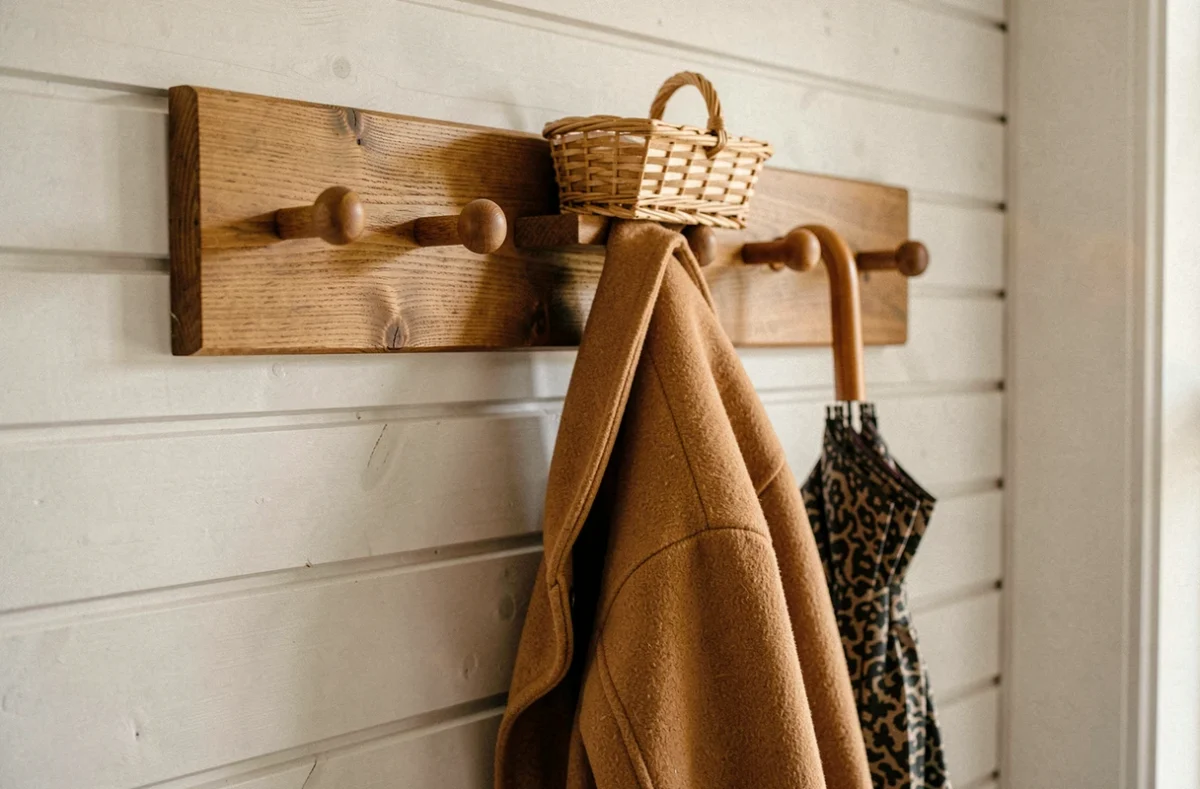
A wall-mounted coat rack frees up floor space compared with a freestanding model. But there’s an important caveat: hanging clothes take up room and encroach on the walkway.
A thick winter coat, a puffer jacket, or a backpack can easily add around 20 centimeters of depth beyond the hook. In a narrow hallway, that may be enough to obstruct a door or make it difficult for two people to pass.
Measure the remaining space with the door open, not closed. Test how much room the clothes will take up by placing a loaded hanger against the wall where you plan to install the rack. If the remaining walkway feels too narrow, reduce the number of hooks or move the rack to a less congested area.
Number of hooks and spacing
Adding more hooks won’t make up for poor spacing. Hooks placed too close together make it difficult to hang thick clothes without them overlapping. Spacing hooks roughly shoulder-width apart allows coats to hang without being squashed together.
For a couple, three to four hooks are enough for everyday use. Families with children may want to add a lower row that younger children can reach, alongside the main row. Two rows of hooks at different heights make better use of the wall than a single overloaded rail.
Wall-mounted coat rack materials: wood, metal, or a combination
The material affects durability, load capacity, and how well the rack fits into the entryway.
Solid wood (oak, beech, walnut) adds warmth and can support substantial weight if the board is thick enough. However, it needs sturdy fixings because the rack itself is heavy. Oiled or waxed finishes stand up to moisture better than untreated wood.
Metal (steel, powder-coated steel, brass) allows for slimmer profiles and a less imposing look. Wire or bent-tube models have a clean design that suits contemporary entryways. Powder-coated metal stands up to wet coats better than untreated wood, which is worth considering in rainy regions.
Combination models (a wooden backplate with metal hooks) bring together both looks. Their strength depends largely on the quality of the join between the two materials, a detail rarely covered in product descriptions.
Wall-mounted coat racks and moisture management in the entryway
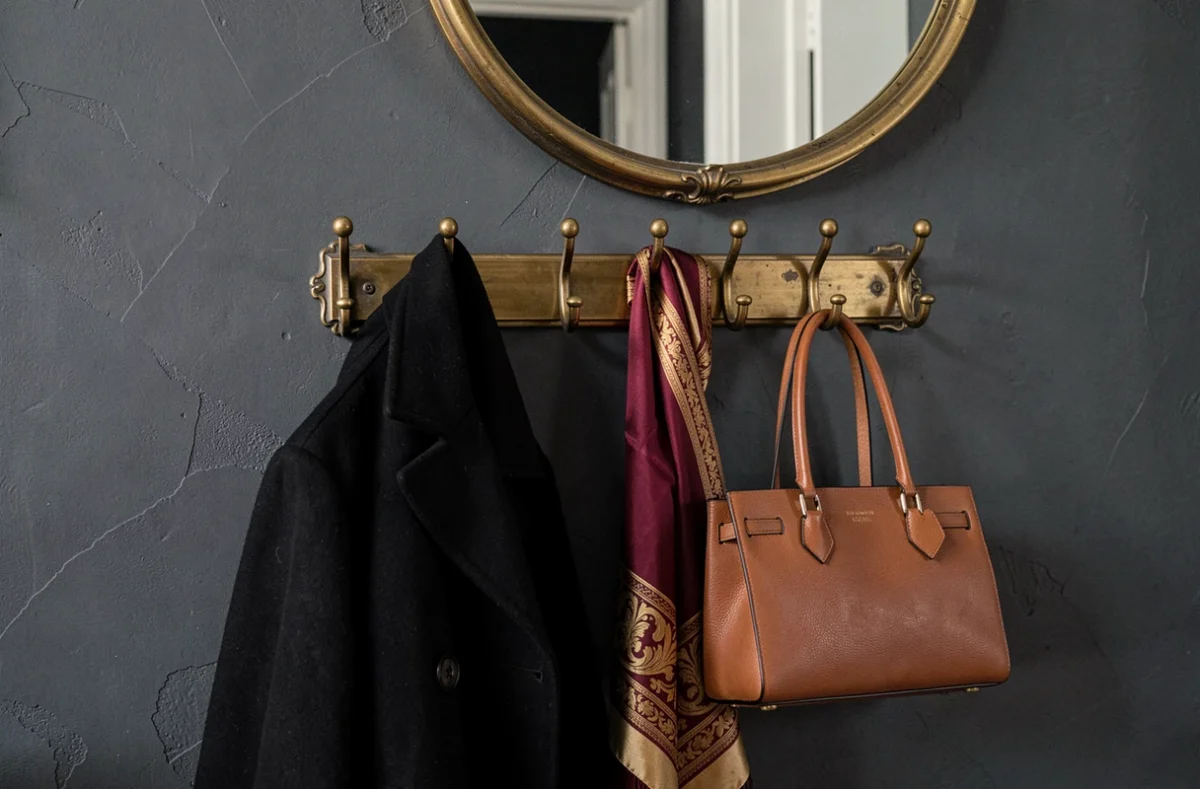
One aspect that’s rarely discussed is that wet clothes release moisture into the air. In a closed, poorly ventilated entryway or a recess with little airflow, this moisture can contribute to condensation on the walls and, over time, mold growth.
Avoid placing the coat rack in front of a ventilation grille or air inlet. Hanging clothes should not block airflow through the room. If the entryway has no natural ventilation, letting soaking-wet coats dry in a better-ventilated room before hanging them up can reduce the risk.
This is especially relevant in apartments, where the entryway often serves as a closed buffer between the landing and the living room. A wall-mounted coat rack in a narrow, windowless hallway will trap more moisture than one installed in an entryway that opens onto the living room.
Which wall-mounted coat rack style suits your entryway?
Style should be guided more by the architecture than by any passing décor trend. Hooks that blend in with the wall create discreet storage in small spaces. A wooden wall panel with integrated hooks adds visual structure to a large entryway without taking up floor space. Shelf-style models that combine a ledge and hooks provide room for keys, mail, or small items, reducing the need for an extra piece of furniture.
Choosing a wall-mounted coat rack involves several technical decisions that go beyond appearance. The type of wall, the actual space taken up by clothes, and the entryway’s ventilation matter just as much to long-term satisfaction as the color or shape of the hooks. A model suited to the wall and available walkway will remain practical even when the whole family uses the entryway every day.