
The school supervisor, officially referred to as a educational assistant, holds a position at the intersection of supervision, mediation, and facilitation within middle and high schools. Their contract, renewable but rarely permanent, places them in a unique position: a daily actor in the educational process without ever benefiting from the status of a tenured civil servant.
Split hours and short contracts: the contractual reality of the school supervisor
Most job descriptions outline the missions of the position. They overlook the contractual structure that conditions everything else. Educational assistants are hired on fixed-term contracts, often aligned with the school calendar, with varying hours depending on the institutions.
Recent job postings show a marked fragmentation of working hours. Contracts of ten to fifteen hours per week, spread over lunch breaks, late afternoons, or supervised study sessions, are common. This fragmented part-time schedule complicates personal organization and limits monthly income.
For students, this format may seem compatible with a university timetable. In practice, the slots imposed by the institution do not always coincide with university classes. Balancing studies and the supervisor position requires tight planning, and exam periods become a balancing act. Anyone considering becoming a supervisor with Career Trotter should anticipate this scheduling constraint before applying.
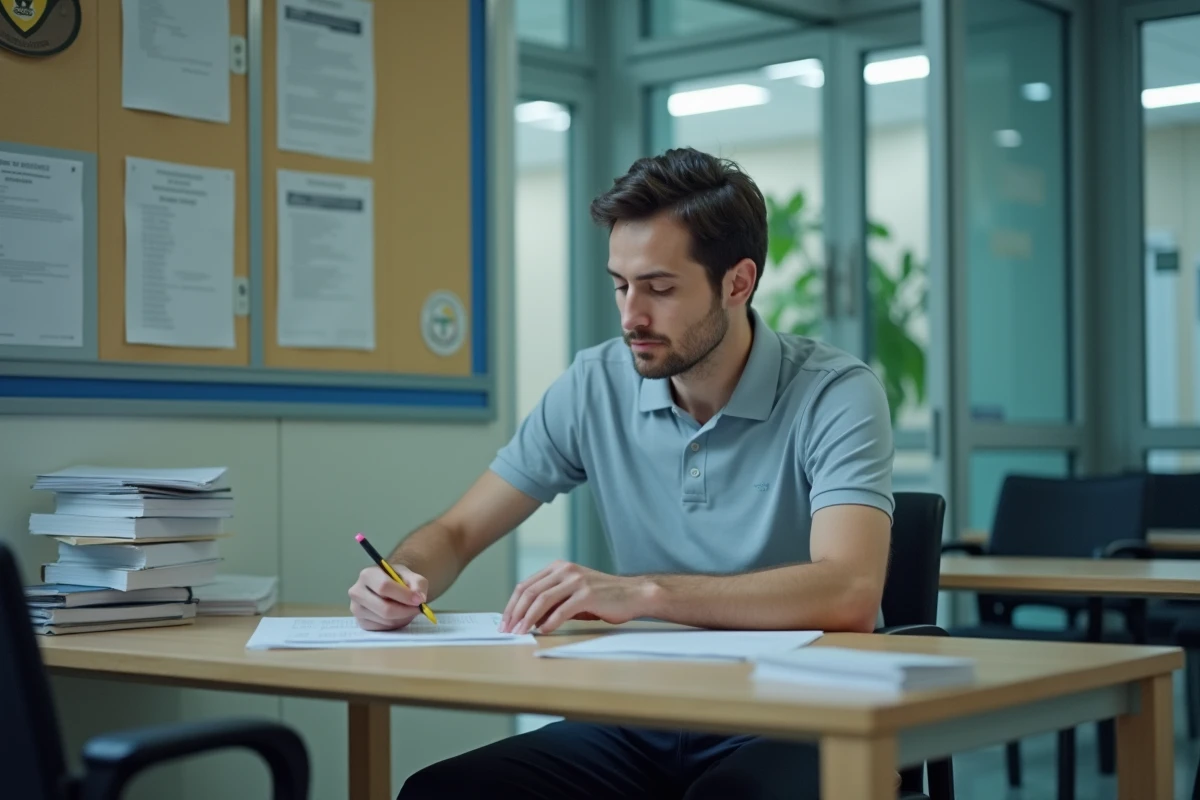
Skills expected by institutions: beyond corridor supervision
The profile sought by recruiters has evolved. Playground supervision and attendance control remain the foundation, but recent job offers add requirements that broaden the scope of the position.
- First aid training (PSC1 or equivalent) is now among the criteria requested in an increasing proportion of job postings, including in the public sector.
- Proficiency in spoken English becomes an explicit asset in certain private middle and high schools, where the supervisor may be required to oversee international students.
- The ability to co-facilitate extracurricular activities (homework help, cultural workshops, childcare) is actively sought, transforming the position into a hybrid educational function.
This rise in employer expectations alters the typical candidate profile. A high school diploma remains the minimum threshold in most cases, but institutions favor candidates engaged in a curriculum related to education, social work, or facilitation.
Conflict management and educational posture: the daily challenge of the supervisor role
Supervising adolescents requires the ability to defuse tensions without the institutional authority of a teacher. The supervisor intervenes in altercations between students, manages disobedience, and sometimes supports situations of distress. They do this within a precise hierarchical framework: they assist the principal education advisor and enforce the internal regulations, without being able to unilaterally decide on a severe sanction.
This intermediate position can generate frustration. In the face of a student in crisis, the supervisor must maintain calm while knowing they do not have the final say on disciplinary responses. The emotional burden of the position is real, and it accumulates over fragmented days where each time slot can bring an unexpected incident.
Feedback from the field shared on social media confirms this aspect: several supervisors describe a daily life marked by unpredictability, where gratification comes from the relationships built with students, but where weariness sets in when institutional support is lacking.
Support and listening: the invisible side of the position
The supervisor is often the first adult a student turns to outside the classroom setting. Family problems, bullying, school anxiety: these topics come up in conversation without appointments or protocols. Knowing how to listen without substituting for a health professional or the CPE is part of the unwritten skills of the position.

Professional development and recognition of the educational assistant position
The supervisor role is often seen as transitional. For many, it serves as a stepping stone towards teaching, social work, or specialized education competitions. The field offers direct knowledge of the school system, a concrete asset during the oral exams of these competitions.
Some institutions, particularly in the private sector or abroad, are now structuring genuine professional development pathways for their supervisors. At Collège Stanislas in Montreal, for example, supervisors gain access to internal committees, professional development activities, and a retirement plan. This model remains minority, but it illustrates a possible shift: the supervisor is no longer just a passing student; they can become a recognized member of the educational community.
In France, the maximum duration of the educational assistant contract remains a barrier. The annual renewal, without the prospect of permanent status, maintains a structural precariousness that neither accumulated experience nor personal investment can compensate for.
The school supervisor role entails much more than physical presence in a corridor. It requires relational skills, resilience to unpredictability, and the ability to adapt to unstable contractual conditions. For those who find educational meaning in it, the position remains a challenging learning ground that is difficult to replicate elsewhere.