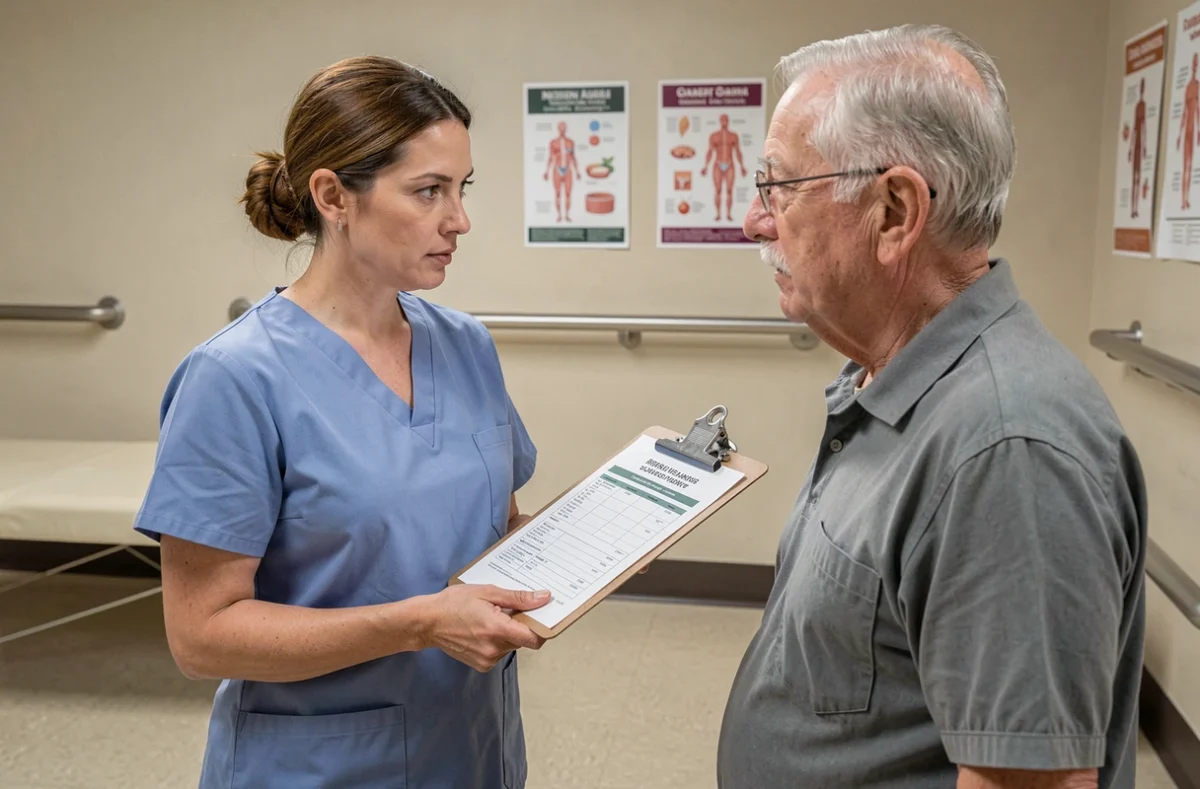
We receive a patient at home, we pull out the Tinetti scale printed from a PDF found online, we rate the 16 items in a few minutes. The score comes in: 22 out of 28. Moderate risk, we move on. Except that this score may not reflect the patient’s balance reality at all. Between the version of the form used, the testing conditions, and the overinterpretation of the result, errors are common and rarely identified.
PDF Form Version: A Source of Error Before Testing
When downloading a PDF of the Tinetti test, we assume that all versions are equal. This is false. There are several variants of the POMA (Performance-Oriented Mobility Assessment), and two forms bearing the same name can differ in their items or weighting.
Some scales in circulation add or remove sub-items in the walking section. Others modify the scoring scale. The result: a score obtained with a modified version is not comparable to a score from the original Mary Tinetti scale. If we follow a patient over time, comparing two assessments made with different forms skews any analysis of progress.
Before scoring, we check that the PDF used includes both sections (balance out of 16 points, walking out of 12 points, total out of 28). We ensure that each item uses a three-level ordinal scale (0, 1, 2). If the document does not match this structure, it is better not to use it.
Common errors that distort the evaluation often start with a poor choice of scale, as detailed in the Tinetti test in PDF in its analysis of common biases.

Field Scoring: Biases Related to Testing Conditions
The Tinetti test requires a hard chair without armrests and a clear corridor or room for walking. At home, we often deal with a chair that is too low, a cluttered corridor, or an uneven floor. These discrepancies directly affect the patient’s performance.
Inadequate Furniture and Environment
If the chair has armrests, the patient leans on them to stand up. The item “standing up” will be rated 1 (possible with arm support) when they might have scored 2 without this available assistance. Furniture influences the scoring as much as the patient’s actual ability.
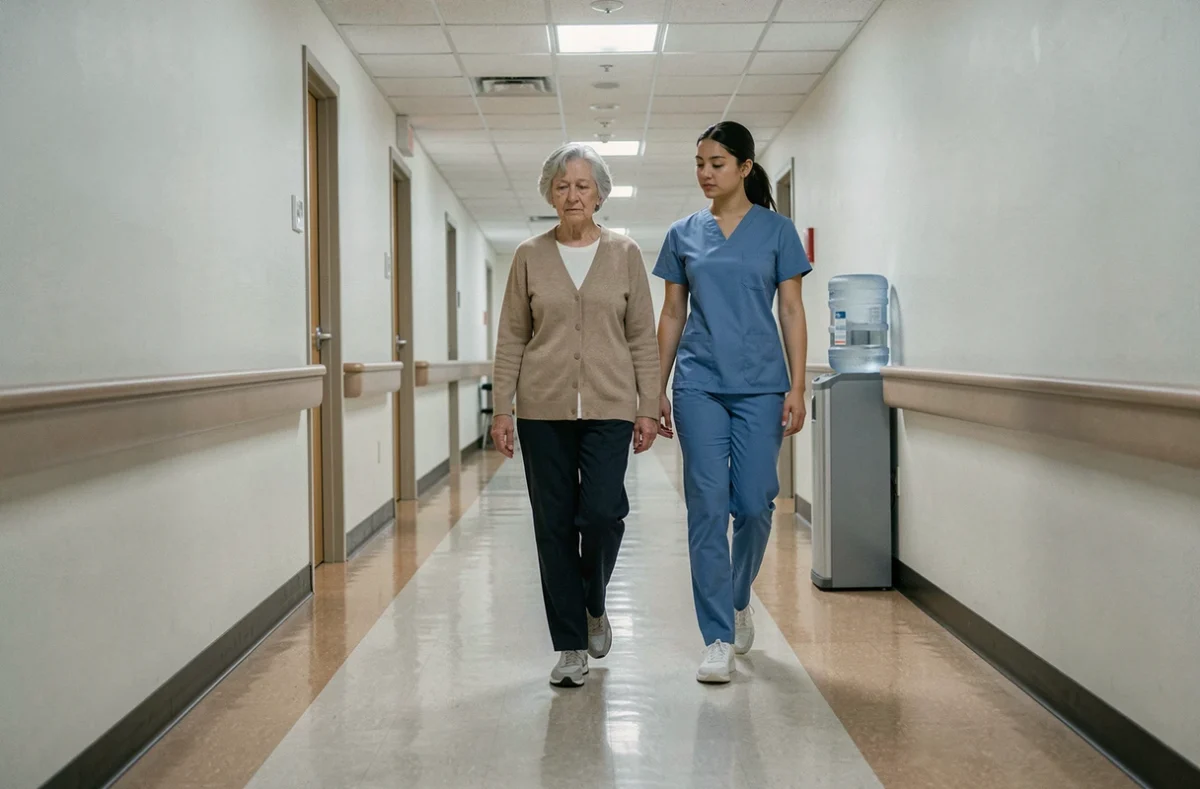
For the walking section, the patient must first walk at a normal pace, then return at a faster pace. In a three-meter corridor, one cannot properly observe the symmetry of the step or the continuity of the walk. The minimum useful length is around eight to ten meters.
Time of Day and Patient’s Condition
Balance and walking fluctuate depending on the time, fatigue, medication intake, or a recent meal. An assessment done in the morning on an empty stomach and another in the late afternoon after a physical therapy session will not yield the same score, even if the patient’s functional capacity has not changed.
- Standardize the testing time when following a patient over multiple assessments
- Systematically note if the patient has taken their usual medications (psychotropics, antihypertensives) before the test
- Record the assistive device used (cane, walker) to compare identical conditions from one assessment to another
Fall Risk Thresholds: Why the Score Alone is Not Enough
Most PDF scales indicate a threshold around 19 or 20 points below which the fall risk would be high. This number is applied as a clear boundary. However, studies use very variable thresholds, from 15 to 26 points, without a single cutoff point being validated for all populations.
An autonomous patient living at home and a resident in a nursing home with a history of multiple falls do not fall under the same alert threshold. The level of autonomy, living environment, ongoing treatments, and fall history change the clinical significance of the same score.
The Tinetti Does Not Predict Falls Alone
A systematic review of prospectively recorded falls concludes that no balance test taken in isolation sufficiently predicts future falls. The Tinetti score identifies a limitation in mobility and balance. It does not replace the medical history, clinical examination, home environment analysis, or medication review.
In practical terms, a score of 23 in a patient on benzodiazepines with a rug in every room represents a much higher risk than a score of 18 in a patient without sedative treatment whose floor is clear. Reducing the evaluation to the number recorded on the PDF misses the essence of the assessment.
Evaluation Report: What the Tinetti Score Should Accompany
A raw score noted in a file without context loses its value. For the assessment to truly serve prevention, the report must mention the testing conditions, the version of the form used, and the environmental factors noted.
- Specify the exact version of the PDF (source, number of items, scoring scale) to ensure comparability
- Describe the furniture used and the available walking distance
- Associate the score with at least one other evaluation tool (Timed Up and Go, single-leg support) to cross-reference results
- Integrate data on daily activities and the overall autonomy of the patient
A reliable fall risk assessment relies on multiple cross-referenced sources of information. The Tinetti is one component, not a verdict. Feedback varies on this point according to practices, but teams that combine at least two functional tests with a home analysis obtain a much more usable picture of the patient’s real situation.